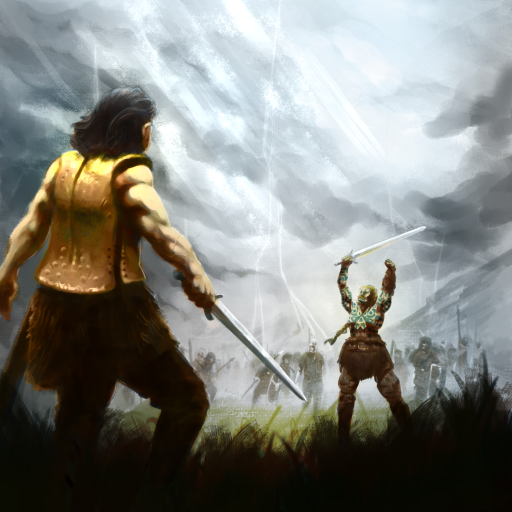
If you’ve read my books, you’ll know that duels play an important role in each story. In Son of the Thunder Goddess, the demigod villain Saorlach begins the siege of Bridunum by pacing before the walls and challenging the noble warriors to come out and face him in single combat.
Where did the inspiration for these scenes come from? I get this question pretty often. Some of my readers have pointed out the parallels to the Biblical story of David and Goliath or even the heroic duels of Homer’s Iliad. These are both influences. Since my childhood was steeped in the Old Testament and Greek Mythology, I probably can’t write anything without channeling those formative influences in some way.
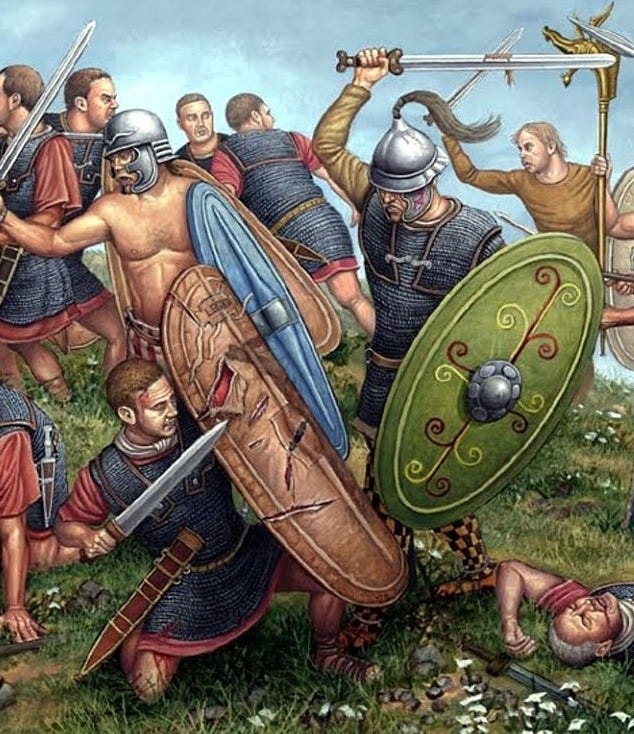
But the more relevant inspiration actually comes from the Celtic world. Ancient Celts, as recorded by Roman historians, were fierce warriors and tended to fight more as individuals than as a disciplined unit. As part of this heroic warrior ethos, they favored single combat between champions.
Livy’s History of Rome
In Livy’s History of Rome, he presents two tales in rapid succession in which a Celtic champion duels a Roman soldier and loses. There is debate among modern historians about whether theses accounts are true (even partially) or just a piece of Roman propaganda. Regardless of their historicity, these stories have shaped how we understand Celtic warfare today, giving us the image of larger than life, heroic figures obsessed with honour, possessed of a height and natural ferocity that strike terror in their foes. As Livy writes of the Gauls—a Celtic people who lived in what is now France, Switzerland, and northern Italy—“the Gauls are a ferocious race, with an innate appetite for fighting.”1
Titus Manlius Torquatus
The first story is of the Roman soldier, Titus Manlius. The armies of the Romans and Gauls are encamped on either side of the River Anio. After several skirmishes which fail to secure the bridge for either side, the Celtic champion emerges:
Then a Gaul of huge build stepped forward onto the empty bridge and, raising his voice as loudly as he could, said: “Come on, then! Let the man that Rome now considers her bravest come forward to fight so that the outcome of our duel may show which people is the better in war!”
The Romans are stunned into silence by the barbarian’s challenge. Livy tells us that none of them want to refuse, but all are afraid of the risk to their army’s morale and reputation should they accept and lose.
At last, the hero of this episode emerges: Titus Manlius. He asks his general for permission to engage first—an important detail as it demonstrates the Roman virtue of duty and obedience above all else, even courage. When his commander gives the go ahead, telling him, “Go, and with heaven’s help demonstrate the invincibility of the Roman name,” Manlius arms for battle with “an infantryman’s shield” and “a Spanish sword.” The Gaul, meanwhile, is “foolishly elated” to see the Roman face him. He is confident of victory even “sticking out his tongue to mock him.”
As the two champions square up to fight before both armies, they are “more like participants in a gladiatorial show than in regular warfare.” Livy also adds that they do not appear evenly matched. On the one hand, we have the giant Gaul who “had a build of extraordinary proportions and was resplendent in his multicoloured garb and his painted armour embossed with gold.”
The Roman, on the other hand, is not imposing at all. His “stature was average for a military man and there was little that was impressive about his weapons, which were serviceable rather than decorative.” Along with his no-nonsense equipment, Manlius is similarly modest in how he approaches the fight. He does not indulge in the ritual of taunting and boasting that characterizes the barbarian Celts.
Having set the stakes and contrasted the two combatants’ weapons, physical size, and demeanour, Livy proceeds to narrate the duel:
The Gaul, his boulder-like frame towering over his opponent, thrust forward his shield with his left hand to counter the weapons of his advancing foe; and with a slashing stroke he brought down his sword to deliver a harmless but loudly resounding blow. The Roman raised the point of his sword and, striking the bottom of the Gaul’s shield with his own, slipped between the man’s body and his weapons, his whole frame being too close to him to be exposed to any risk of a wound. He thereupon delivered one thrust and then another, piercing the man’s belly and groin, bringing him crashing down and laying him out over a larger area.
After slaying his Gallic foe, Manlius takes “a single torque, which was spattered with blood, and put it around his own neck.” Livy assures us that the Roman “spared his corpse all other forms of abuse” but in order to obtain the torque, he likely he had to at the very least behead his fallen enemy.2
As Manlius dons his opponent’s torque, the Roman soldiers go wild with celebration and give him the cognomen (nickname) Torquatus, in honour of the plunder he won from this duel. Manlius’s victory establishes his reputation, setting the stage for his later rise to the office of consul and dictator, while also deciding the conflict itself. For, after seeing their champion bested, “the Gallic army abandoned their camp in a panic during the night that followed.”
Marcus Valerius Corvus
The second story takes place twelve years later and follows very similar lines to that of Titus Manlius. Once again, the Romans are at war with the Gauls. While the legion is encamped, they receive a challenge to one-on-one combat:
A Gaul came forward who stood out because of his size and armour. He obtained silence by beating his shield with his spear and then, by means of an interpreter, issued a challenge for one of the Romans to decide this issue with him in a duel.
The young military tribune Marcus Valerius is eager to take on the challenge. After receiving approval from his consul, he abandons the safety of the fort and reaches a spot between both armies where the duel will take place.
At this point, Valerius’s story diverges from the template previously established. For, just as he is about to fight, “a raven suddenly landed on his helmet, facing his adversary.” Ancient peoples were accustomed to interpreting many natural occurrences as omens—especially anything to do with birds. The Romans even had a whole discipline, called augury, devoted to interpreting bird sightings.
In Valerius’s case, one doesn’t have to stretch very far to see this raven as a sign of divine favour. Livy writes:
The tribune first welcomed this as a heaven-sent omen, and then made a prayer that whichever god or goddess had sent him the favourable augury would stand by him with grace and favour.
Valerius closes with his enemy, confident that a god or goddess is fighting alongside him. The raven, meanwhile, is not content merely to embolden him, but actively interferes:
Whenever the men clashed it raised itself with its wings and attacked the face and eyes of the Roman’s opponent with its beak and talons. Finally, terrified by such a portentous manifestation, and dazed and half-blinded, the Gaul was cut down by Valerius, and the raven took off and vanished as it headed east.
This time, the Gauls do not run away when their champion dies. Instead, as Valerius “started stripping the spoils from the body,” they rush towards him in a fury. The Romans run to meet them, and soon “a scuffle broke out there, around the body of the prostrate Gaul, and that turned into a ferocious brawl.” As the battle rages about the fallen hero, reminiscent of many similar scenes from the Iliad, the Romans commit the full weight of their legions, slaughtering and routing their Celtic foes.
The result, as with the story of Manlius, is a decisive Roman triumph. Valerius also receives the new and fitting cognomen of Corvus for the raven that brought him victory.
In these historical accounts, we get a fascinating glimpse of the heroic ethos of the ancient Celts, at least as understood by their Roman enemies. In both stories, it is the Gaul who initiates, who stands before the Roman army, taunting and issuing the challenge to fight. The Romans accept and ultimately triumph, but the love of single combat seems to be more integral to Gallic warfare than Roman.
These duels not only determine who is the mightier of two champions but also have the potential to decide the battle itself by proving the superiority of the victor’s people. And, as we saw with Valerius, the gods themselves may play a part, assisting their favoured champion.
The image of the huge, intimidating, and boasting Celtic champion that emerges from Livy’s history and many others is one I’ve drawn on heavily when writing Son of the Thunder Goddess and its sequels. Bringing in this heroic warrior ethos allows me to ground my stories in ancient history and add a greater sense of authenticity to my fantasy worlds.
If you enjoyed this post, consider checking out my epic fantasy series, The Lays of Athewain. It builds on a lifelong love of mythology and literature and engages with many of the themes I explore here on Substack.
- Throughout this post, I am citing Livy, Rome’s Italian Wars: Books 6-10, Translated by J.C. Yardley, Oxford World Classics, 2013. All passages are from Book Seven. ↩︎
Leave a Reply