Andrew LiVecchi is a humanities professor and author of epic fantasy inspired by a lifelong obsession with ancient and medieval history, mythology, and classic literature. His book, Son of the Thunder Goddess, is available for purchase.
One of the most challenging tasks in writing epic fantasy inspired by ancient or medieval Europe is remaining faithful to the spirit of the age while avoiding the tendency to filter everything through a contemporary worldview. To some extent this is impossible. We can’t help but be people of our time, nor can we fully pretend to be ancient bards or medieval monks, ignorant of the developments in history, natural science, and psychology since 1500. What we can do is seek to embody the sense of magic and enchantment of premodernity, while still writing stories that remain accessible to modern readers.
Premodern people differed greatly from us, not merely in their technology and social systems, but at a deeper level in their values, beliefs, and very sense of self. That sense of self is what I want to explore further in this essay. One of the most marked shifts between an enchanted and disenchanted age lies in how humanity understood its relationship to the surrounding world. Broadly speaking, for premodernity, the self was conceived as porous, while in our own disenchanted age, we understand the self to be buffered, or closed.
I draw my understanding of these terms from the work of Charles Taylor, probably the most well-known theorist of enchantment and secularity in the West. In his essay “Disenchantment—Reenchantment,”1 Taylor writes of the enchanted age:
The first feature of this world is that it was one filled with spirits and moral forces, and one, moreover, in which these forces impinged on human beings; that is, the boundary between the self and these forces was somewhat porous. There were spirits of the wood, or of the wilderness areas. There were objects with powers to wreak good or ill, such as relics (good) and love potions (not so unambiguously good). I speak of “moral” forces to mark this point, that the causality of certain physical objects was directed to good or ill. One could sum this up by saying that this was a world of ‘magic.’ (p. 57)
Taylor paints a vivid picture of premodernity, a world teeming with agentic, moral forces beyond the human being—demons and spirits of the wilderness, as well as gods and saints and angels. For enchanted man, these beings were not merely hypothetical, unseen forces whose existence one assented to in a rational, credal sense. They were deeply integrated in all human activity, threatening harm or promising aid in accordance with their own moral natures and the natures of the human beings who interacted with them.
In a modern, post-secular framework, we generally attribute moral agency only to human beings and deny that objects such as rings and tombs, or natural phenomena such as floods or thunderstorms have a will. But that same distinction is not made in premodernity. Both objects and elements of the natural world can act as moral forces. Taylor draws on such examples as the relics of medieval saints—that cure disease or harm evildoers, acting as an extension of the saint themselves—as well as beliefs about the consecrated Host or other objects that in themselves have the power and will to act for good or evil.
Taylor writes:
In the enchanted world, the line between personal agency and impersonal force was not at all clearly drawn. We see this again in the case of relics. The cures effected by them, or the curses laid on people who stole them or otherwise mishandled them, were seen both as emanating from them, as loci of power, and also as coming from the goodwill, or anger, of the saint they belonged to. (p. 60)
These objects may not be sentient exactly, but they do take moral action. Long after a saint is dead, their bones and the tomb containing them retain some of the power that the holy figure possessed in life. Saint Martin of Tours, a bishop in Late Antique Gaul, has many such stories. On the one hand, his shrine was a popular site for those seeking healing for various illnesses—even exorcisms for the possessed. On the other hand, there is the story of a Hunnic mercenary who steals a crown from Martin’s shrine. As punishment, the Hun is blinded, his sight restored only when he returns Martin’s crown to its rightful place.2 In these stories of healing blessing and blinding curse, we find the relic of Saint Martin’s bones acting with the same moral authority and clarity as the living saint himself. This is, in essence, what a porous mind entails.
As Taylor further explains:
The enchanted world, in contrast to our universe of buffered selves and “minds,” shows a perplexing absence of certain boundaries that seem to us essential. So in the premodern world, meanings do not inhere only in minds, but can reside in things, or in various kinds of extrahuman but intracosmic subjects. (p. 60)
In an enchanted world, the self is porous, vulnerable to intrusion and manipulation from a host of moral forces. Demons enter our minds to tempt us, and angels send us warning dreams. Aphrodite makes Helen of Sparta fall in love with Paris and abandon her husband, while the God of the Old Testament hardens Pharaoh’s heart so that he refuses to let the Israelites leave Egypt.3
Consider the following representative passage from the Book of Job:4
If he [God] withholds the waters, they dry up; if he sends them out, they overwhelm the land. (Job 12:15)
In such a model, drought and flood are to be understood, not through modern explanations of weather systems, water cycles, or gravity, but as the actions of a moral agent: God. God may choose to keep the waters in balance. Or he may tip that balance to either side, depriving or overwhelming the land with water. Either way, the speaker attributes both the absence and presence of catastrophe to the choices of a non-human moral agent.
We see a similar porousness with omens in Greek mythology. In Homer’s Odyssey,5 there are numerous examples of augury, the art of reading the future or will of the gods through the flight of birds. As Odysseus’s son Telemachus is about to take his leave of Sparta’s king and queen, Menelaus and Helen, they catch sight of a remarkable omen:
A bird flew past on the right,
an eagle clutching a huge white goose in its talons,
plucked from the household yards. (15.179-81)
And as everyone is wondering “how to read the omen rightly” (15.189), Helen steps in and provides an interpretation:
“Listen to me and I will be your prophet,
sure as the gods have flashed it in my mind
and it will come to pass, I know it will.
Just as the eagle swooped down from the crags
where it was born and bred, just as it snatched
that goose fattened up for the kill inside the house,
so, after many trials and roving long and hard,
Odysseus will descend on his house and take revenge.” (15.191-98)
The eagle’s flight is imbued with moral significance and speaks directly to the poem’s climax where Odysseus will at last do battle with the suitors who despoil his home and woo his wife. Telemachus is not merely projecting onto nature what he wishes to see; the birds themselves act out a cosmic moral desire for justice against the suitors.
In opposition to the porous self, we in this modern, post-secular age see the individual as buffered, a self-contained person with thoughts and feelings that originate within the recesses of their own mind. Dreams, for instance, are coded messages from our own unconscious, not the workings of a god or spirit. If we act in surprising, irrational, or even self-destructive ways, we attribute our behaviour, not to the interference of a god, but to our own cognitive biases, social conditioning, and unresolved childhood trauma.
As Taylor writes:
The process of disenchantment is the disappearance of this world, and the substitution of what we live today: a world in which the only locus of thoughts, feelings, spiritual élan is what we call minds; the only minds in the cosmos are those of humans […] and minds are bounded, so that these thoughts, feelings, and so forth, are situated “within” them.” (p. 58)
But in our modern, post-Galilean world, there is no place for the web of meanings inherent in enchantment:
If thoughts and meanings are only in minds, then there can be no “charged” objects, and the causal relations between things cannot be in any way dependent on their meanings, which must be projected on them from our minds. In other words, the physical world, outside the mind, must proceed by causal laws that in no way turn on the moral meanings things have for us. (p. 62)
This certainty, that the physical world “must proceed by causal laws,” is, of course, central to the work of the Scientific Revolution and all of the advances we have made since Galileo and Newton. Even if we concede that God (or the gods) created the universe, we assert that matter must conform to a set of knowable, stable rules. Moreover, matter itself cannot act with moral purpose. Minds alone can do that, and we recognize the existence only of human minds.
At this point, I should make one thing clear: I am not arguing for a true return to enchantment or a dismissal of rationalism, Enlightenment, the scientific method, or any of the other developments that have led to, or resulted from, disenchantment.
Instead, I am approaching this topic as a fantasy author. Fantasy is, in many ways, the attempt of those living in a disenchanted age to recover some of the enchantment and magic of the past. It is no coincidence that the settings of epic fantasy stories are primarily premodern, featuring secondary worlds clearly indebted to ancient and medieval cultures. Even urban fantasy usually draws on gods or creatures from the premodern past, such as werewolves, vampires, or Norse gods, placing them in a contemporary setting.
As modern writers, we do need to conform to the conventions of modern genre fiction. We must strive to craft characters with realistic psychology, tell stories that follow a satisfying arc, and handle point-of-view according to current conventions. Failure to meet these basic criteria would alienate most readers and limit our reach.
But I think we should push back against some of the features that have become dominant in fantasy and which feel alien to an enchanted age. I am thinking especially of the proliferation of “hard” magic systems, a term popularized by Brandon Sanderson, the most famous proponent of this approach. In so much of epic fantasy—and the related subgenres Progression Fantasy and LitRPG—we get stories that employ the mere trappings of premodernity—swords and spears, kings and queens, castles and longships, wizards and dragons—with hardly any of its enchantment.
Magic in these books must be part of a system, conforming to constant, predictable rules, existing as a knowable, harnessable force like electricity. A magic “user” in these stories is less like the sorcerers of actual mythology and romance (e.g. Circe or Merlin) and more like a scientist who takes for granted the existence of laws of nature such as gravity or thermodynamics and exploits those laws to produce technology. The result is a presentation of magic that isn’t magic at all, and a thoroughly disenchanted fantasy world.
To recapture the enchantment and magic of premodernity, we need to resist this Sandersonian, industrial impulse to systematize, and instead model our approach on ancient and medieval history and literature.
To be clear, I don’t think it is enough simply to turn our magic systems “soft.” In fact, much of the soft vs hard magic systems debate you see on social media seems to miss the broader point. What makes the work of writers like J.R.R. Tolkien or Ursula Le Guin so powerful is not that they present soft magic systems. It’s that they are deeply immersed in mythology and romance and that their books capture the porousness of an enchanted age.
Consider how Tolkien presents the One Ring and what makes it such a compelling magical object. Again, it’s not about the soft-hard magic divide. Sure, we don’t know what the One Ring’s “stats” are. But that’s not because Tolkien secretly had a stat sheet and kept it hidden from the reader for the sake of mystery. Tolkien was playing an entirely different game than most modern writers, because he understood how premodern people thought.
The ring does have some “rules.” It allows Frodo to turn invisible whenever he places it on his finger. But it is not simply a tool or a piece of technology masquerading as a magical object. It possesses an evil will, because it was forged by an evil Sauron. The object is not sentient, but it does at times exert a wicked moral agency as an extension of the moral agent that forged it. This is in keeping with the medieval attitude to objects we saw earlier with Saint Martin’s shrine.
Tolkien adopts a similar approach to other physical objects in his books. There’s Bilbo and Frodo’s sword, Sting, which glows blue in the presence of orcs because it bears the antipathies of its Elvish crafters. Or the Phial of Galadriel containing light from Eärendil’s star, which protects the hobbits from Shelob.
There are many more examples of porousness we could look at in The Lord of the Rings (perhaps the topic of a future essay?). But I’d like to wrap up this essay by posing a challenge to any of my fellow fantasy authors interested in the project of reclaiming enchantment in their writing:
- Imagine your characters as not only deeply religious, but also what we moderns would deride as superstitious. Write characters who believe that nature itself is the handiwork of the gods and that even natural phenomena can be ascribed to the activities of moral agents, human and divine.
- Present your characters as porous, susceptible to influence from non-human forces. Let their thoughts, dreams, and actions be capable of interference from gods and spirits.
I understand the challenges. Sanderson is one of the best selling fantasy authors working today, and magic systems are all the rage. Moreover, the concept of a porous self runs counter to so much of what we take for granted when it comes to character. Modern fantasy, like other genre fiction, allows only for either a deep, limited third-person or a first person perspective. When writing in either of these perspectives, we must go deep into the subjectivity of a single character, whom we understand to be an autonomous entity, a closed loop, a buffered self. Any thoughts that occur to that person originate from their own consciousness or are suggested externally by another person. More importantly, their actions are their own. If they do something heroic or villainous, we understand it to be fundamentally their action as a moral agent, not the result of some external force.
Like I said, it is a challenge. But I don’t believe such a project is doomed to failure. Readers still adore The Lord of the Rings and the vast body of epics, romances, mythologies, and sagas that inspired it. We can speak to that longing for something beyond the disenchanted materialism of our present age and immerse our readers in a porous world of magic. That task will demand great effort and a true love for and delight in the literature of an enchanted world.
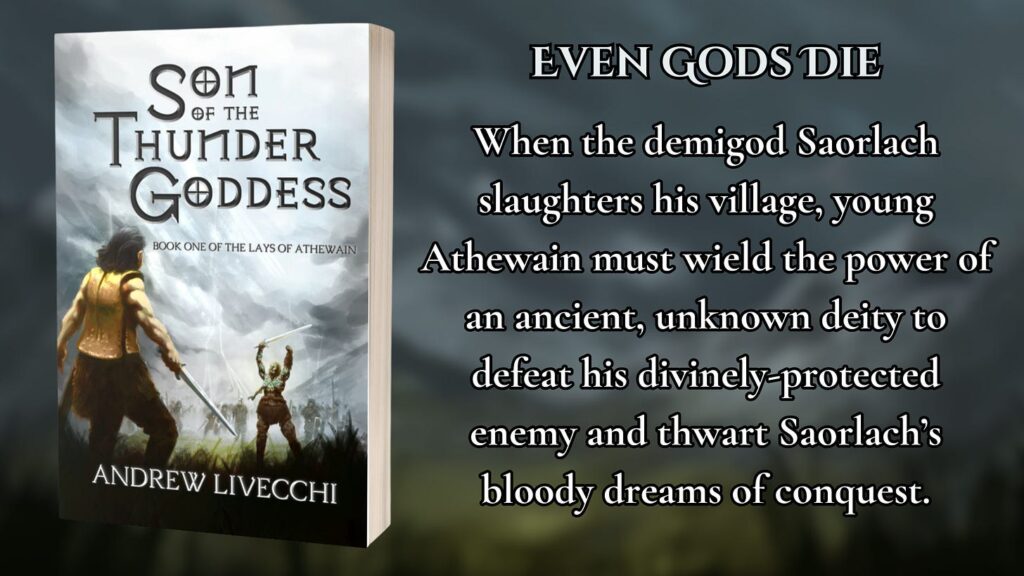
If you enjoyed this post, consider checking out my epic fantasy series, The Lays of Athewain. It builds on a lifelong love of mythology and literature and engages with many of the themes I explore here on Substack.
- Charles Taylor. “Disenchantment—Reenchantment.” The Joy of Secularism: 11 Essays for How We Live Now. Edited by George Levine. Princeton University Press, 2011, pp. 57-73. ↩︎
- Mount, Maurus, and Bryan Ward-Perkins. “Paulinus of Périgueux, Life of Saint Martin.” Cult of Saints, E06355, http://csla.history.ox.ac.uk/record.php?recid=E06355. ↩︎
- “But the Lord hardened the heart of Pharaoh, and he would not listen to them, just as the Lord had spoken to Moses” (Exodus 9:12, NRSVUE). ↩︎
- “Book of Job.” The Bible. New Revised Standard Version Updated Edition, Zondervan, 2021. ↩︎
- Homer. The Odyssey. Translated by Robert Fagles, introduction and notes by Bernard Knox. Penguin Books, 1996. ↩︎
Leave a Reply